Candidate screening that shows its work.
Nexus reads every application to a role, scores it against five published criteria, and shows how each number was reached. It never accepts or rejects anyone. Your recruiters do.
Or try the interactive walkthrough: set the parameters, compute a score yourself.
From a one-line need to a shortlist, with a person at every decision.
Each job follows the same eight steps, and up to three of them stop and wait for a recruiter: scoping is skipped when you paste an existing ad, and pre-screening only runs above 50 applicants. Progress is saved at every step, so work can pause and resume later.
- 1
Need
Describe the role in a sentence, or paste a job ad you already have.
- 2
Scoping
Nexus asks what it needs to know: skills, experience, location, contract.
You approve - 3
Job ad
Nexus drafts the ad. Nothing is published until you approve it.
You approve - 4
Publishing
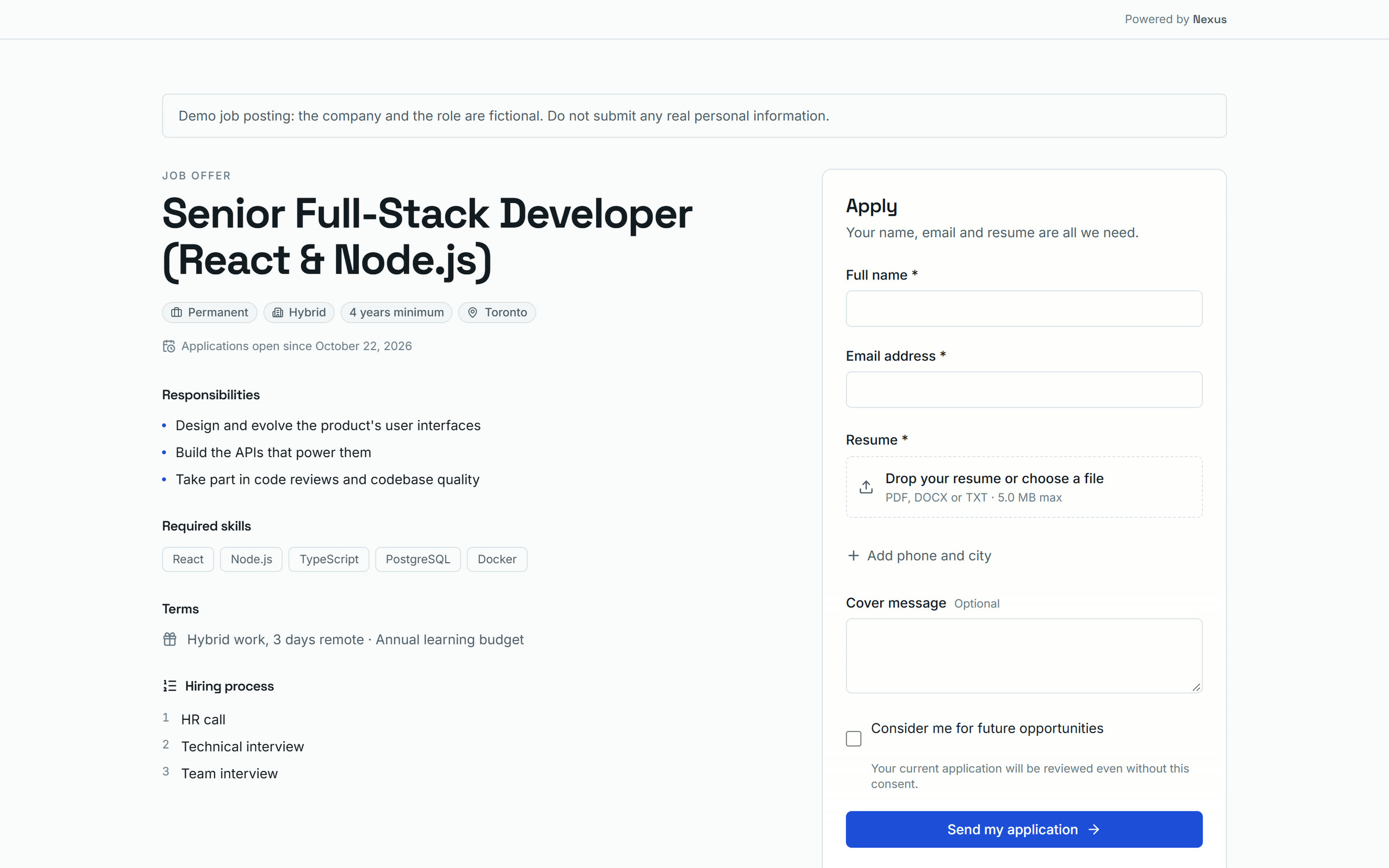
A public application page you can open, pause or close.
- 5
Applications
Candidates apply without an account. Each CV is read and structured.
- 6
Pre-screening
Above 50 applicants, a fast first sort. Rejection emails are drafted, never sent.
You approve - 7
Evaluation
Only when you ask, on the number of applications the button states.
- 8
Decision
Ranking, candidate files, a printable report with interview questions.
Amber marks a decision that belongs to a person, on this page and in the product.
Every score comes apart into five numbers you can check.
The match score is a weighted sum, computed in code. Four of the five criteria are deterministic: the same CV against the same job always gets the same result. A language model contributes one criterion, worth 10%, and only ever sees an anonymized profile.
A fictional candidate from the demonstration data. Same weights and same weighted sum as a real evaluation; the demo presets semantic fit and consistency instead of calling the models.
| Criterion | Weight | Source | Score | Points |
|---|---|---|---|---|
| SkillsShare of the job’s required skills that the CV actually mentions. A skill the CV does not name does not count. | 30% | Code | 100 | 30.0 |
| Semantic fitSimilarity between the CV and the job ad, from an embedding model that runs inside Nexus, not through an outside service. | 25% | Code | 95 | 23.8 |
| ExperienceYears of experience against the job’s minimum, capped by what the CV’s own dates support. | 20% | Code | 100 | 20.0 |
| LocationAverage of region match (100 if it matches, 0 if not, 50 if unknown) and availability (100 if immediate, down to 33; 50 if unknown). Without a job location, only availability counts. | 15% | Code | 100 | 15.0 |
| ConsistencyA language model reviews the anonymized profile against the role, bounded between 0 and 100, with a written justification. | 10% | Model | 86 | 8.6 |
| Match score | 100% | 97 |
Weights are fixed and identical for every candidate. Each required skill is also marked “confirmed by the CV” or “to verify”, and the model’s self-reported confidence is labeled as such, because it is not calibrated.
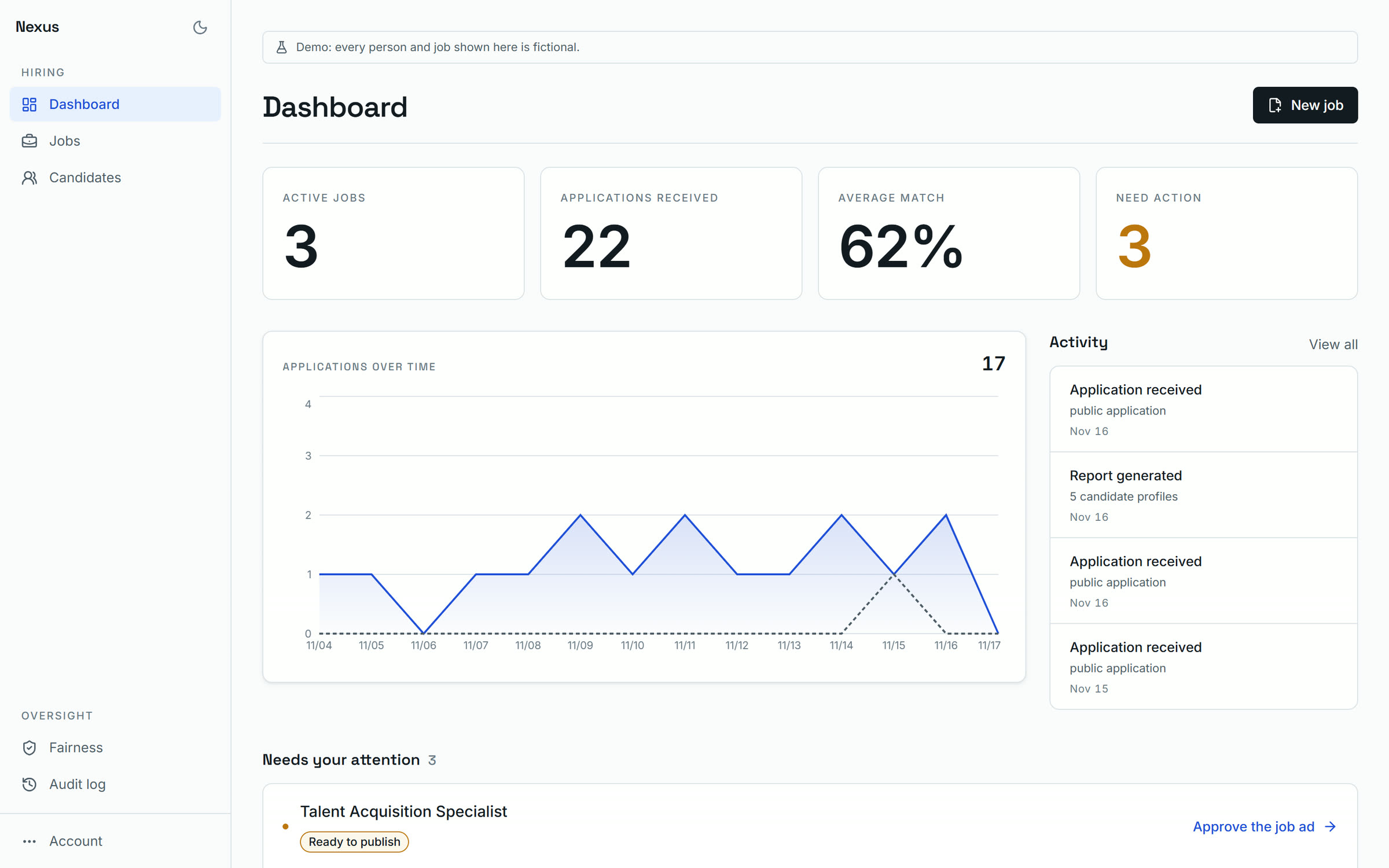
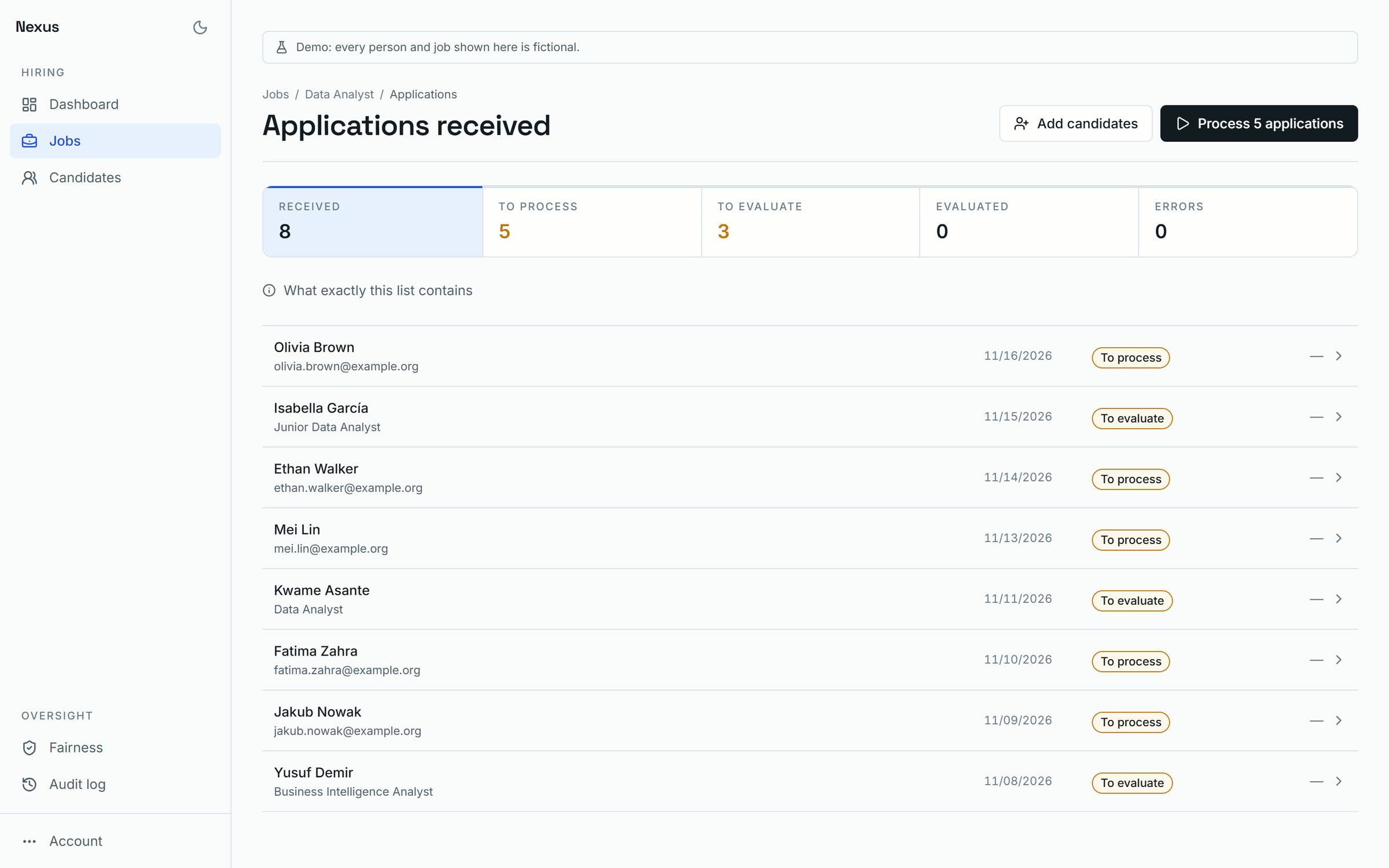
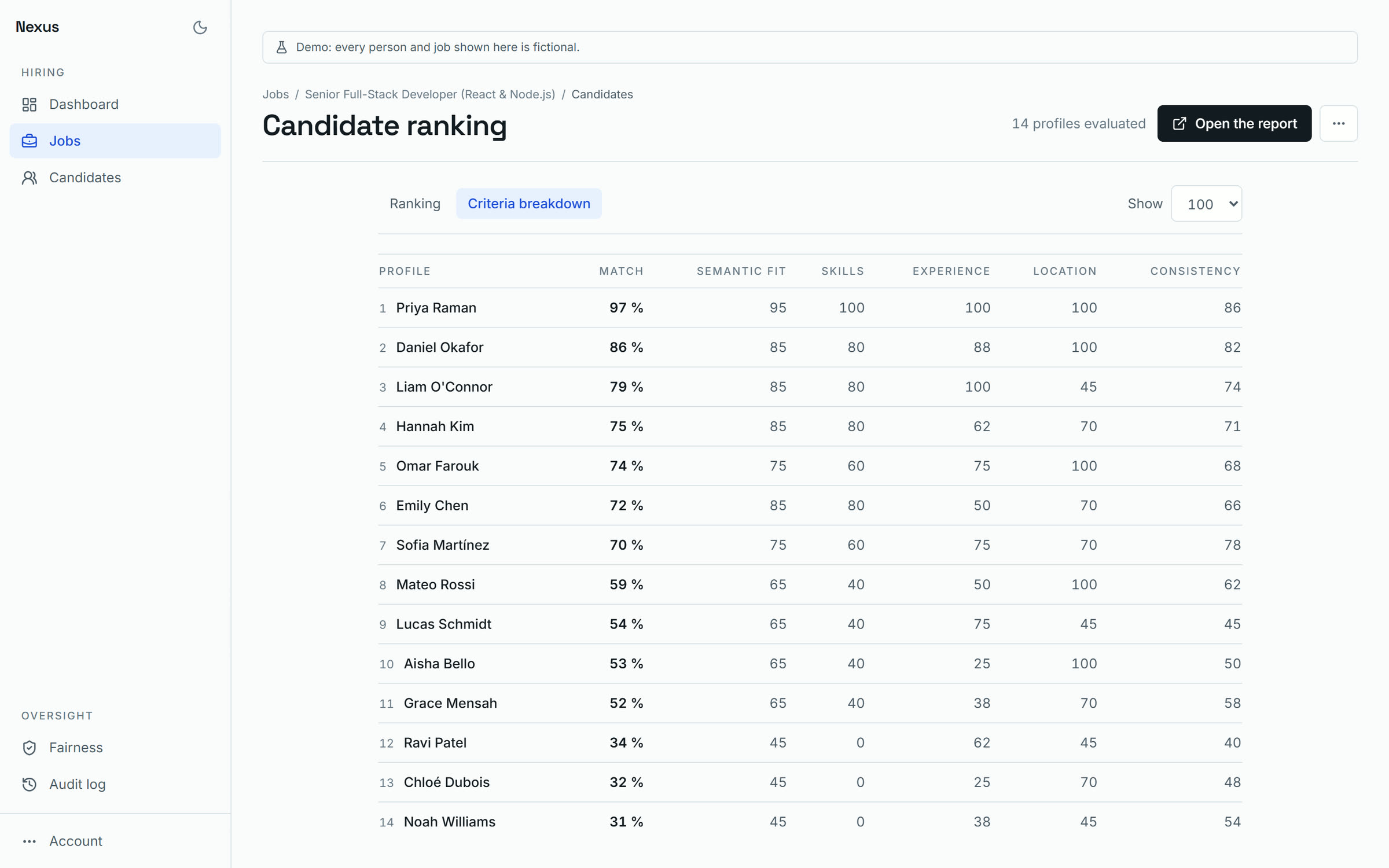
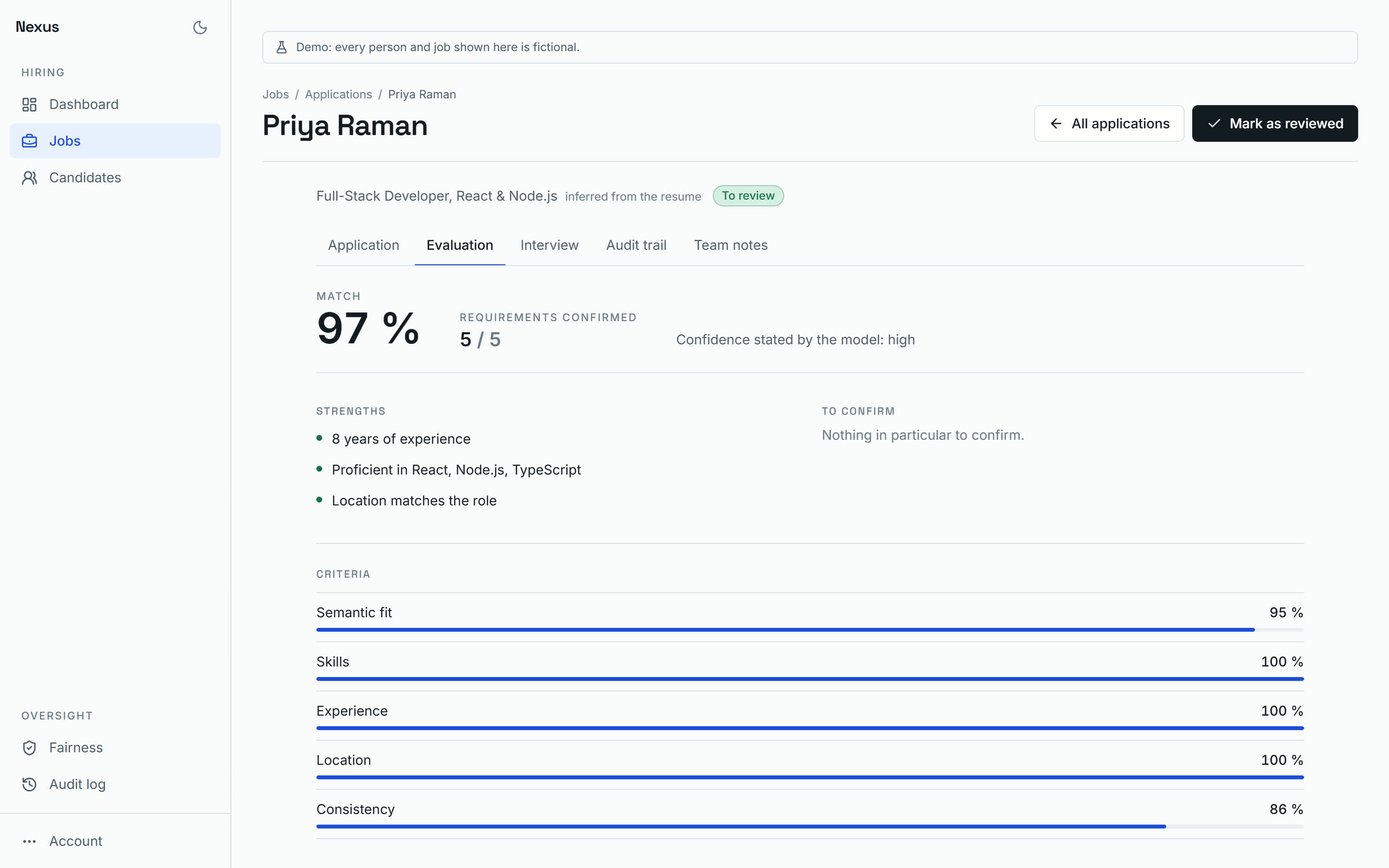
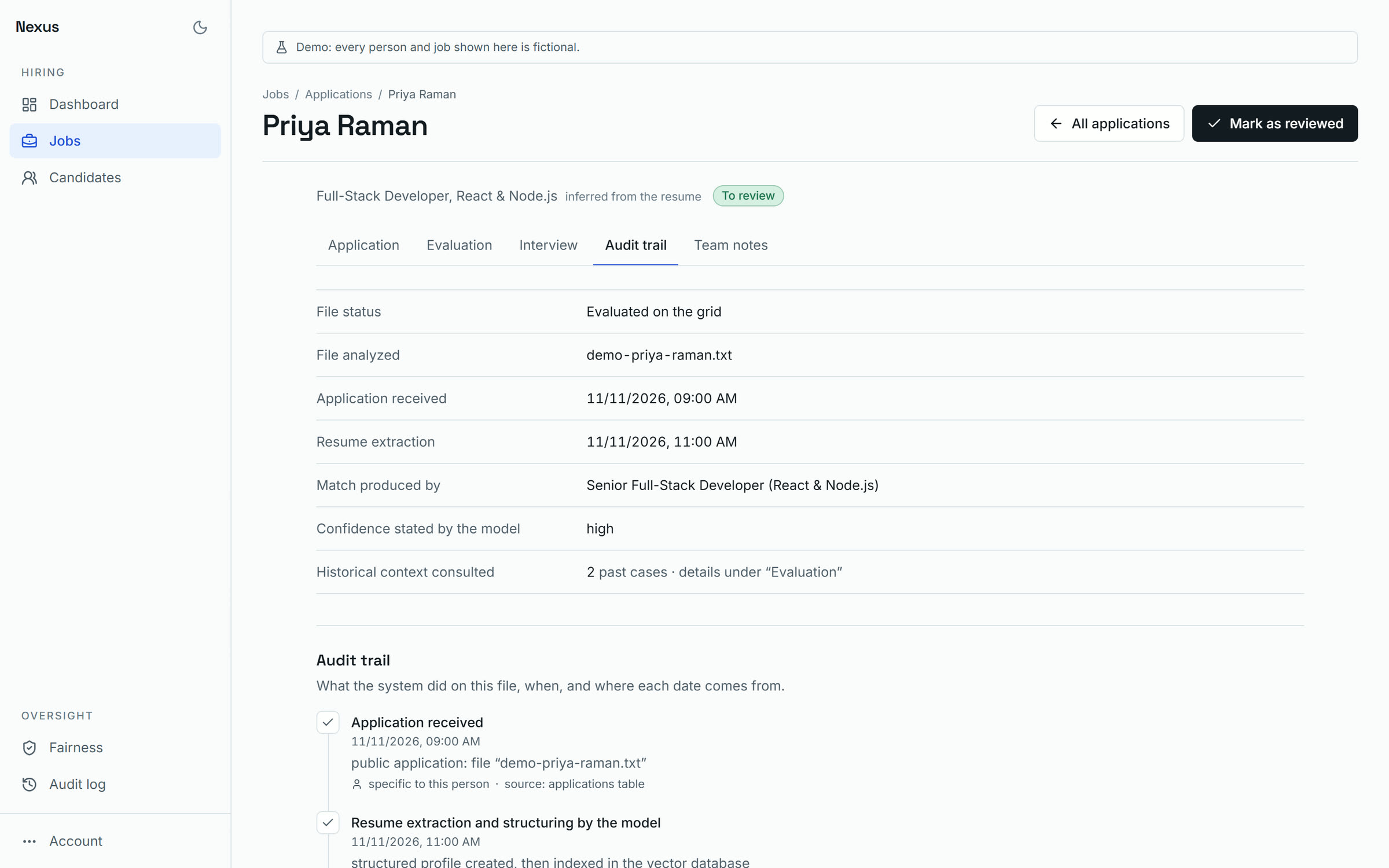
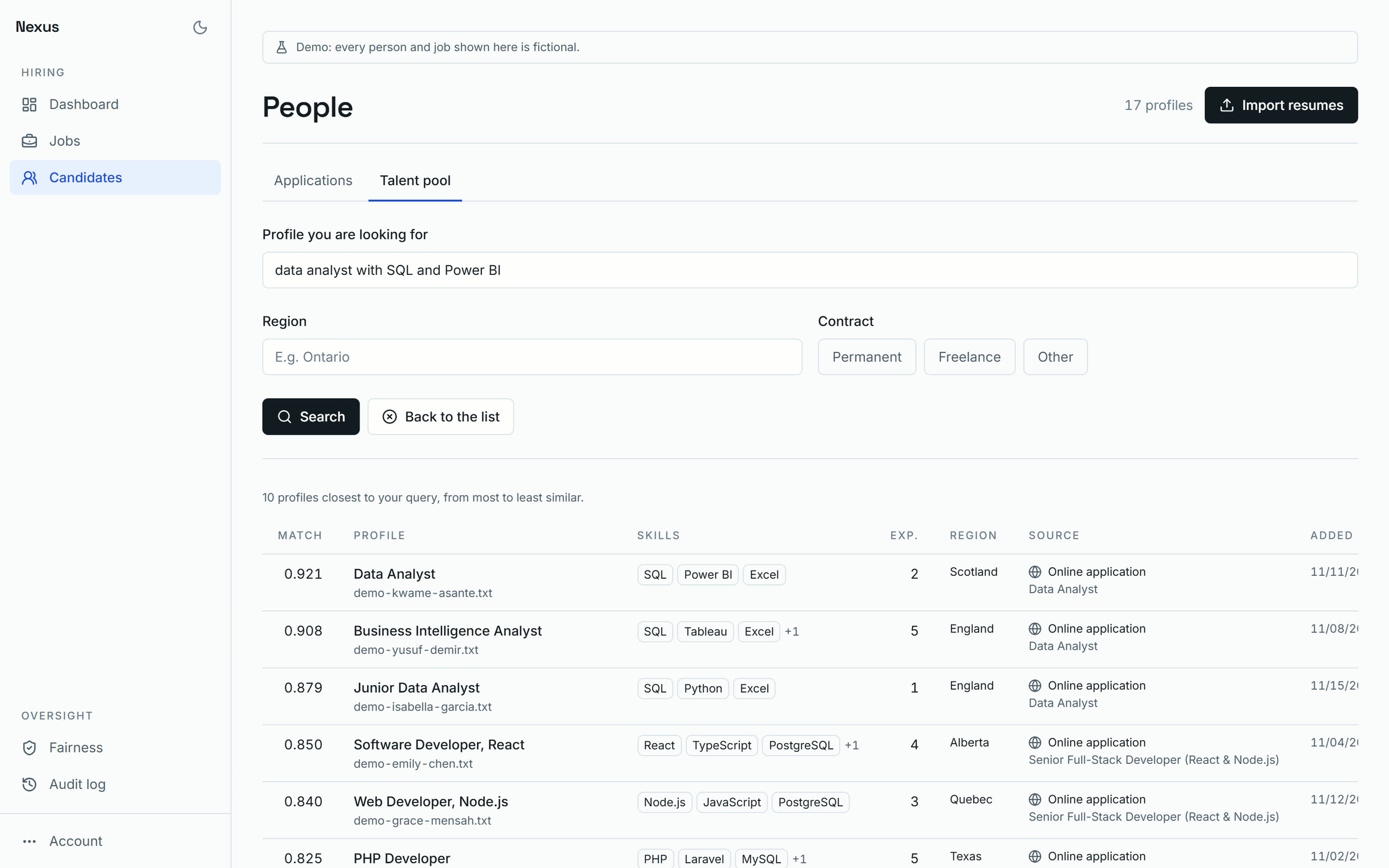
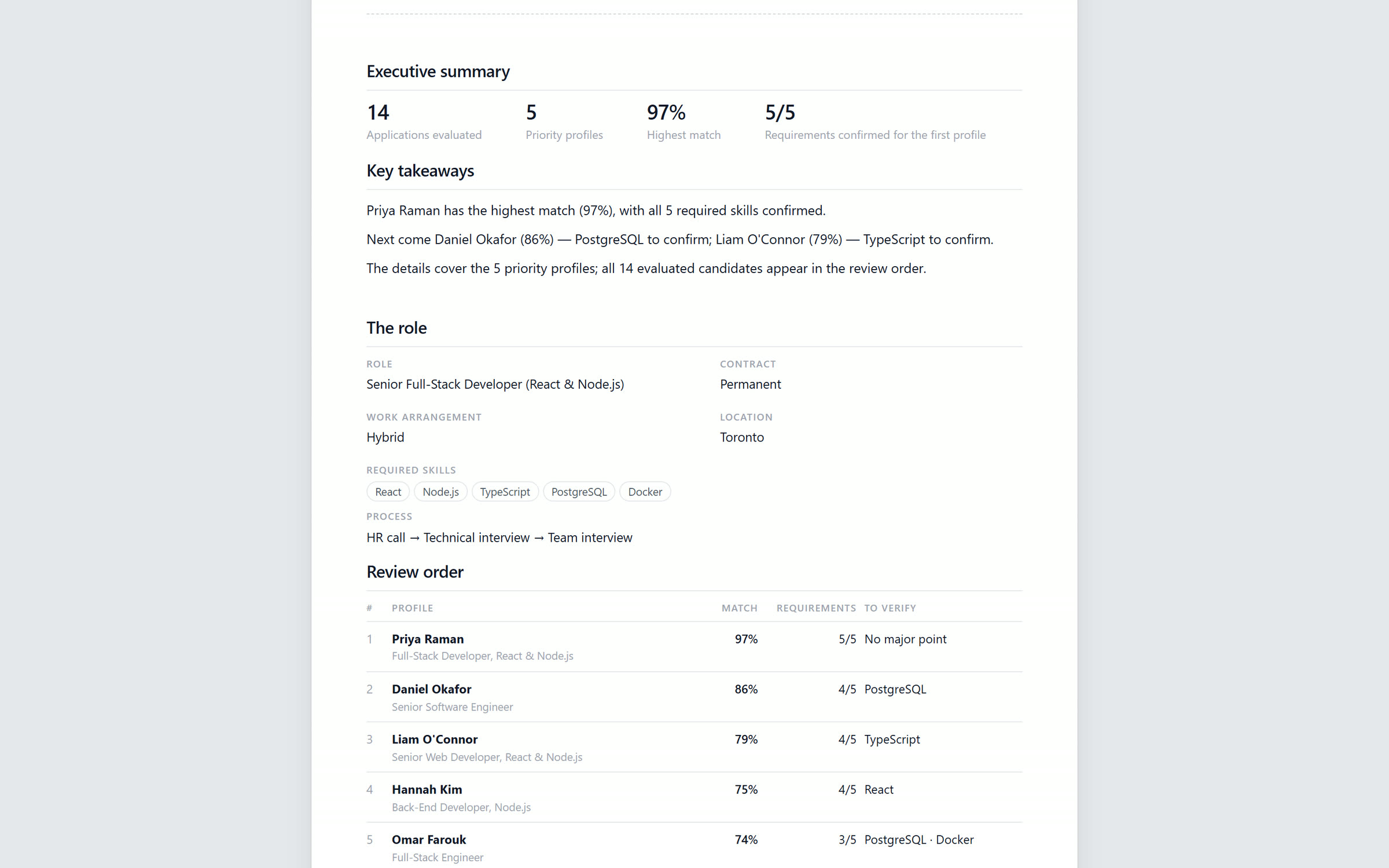
The screens your team will use.
Real screens from the demonstration instance, in English. The interface is also available in French.
Where the model works, and where it stops.
A language model reads, drafts and explains. It decides nothing on its own: every output either goes to a person for approval or counts for 10% of a score.
| Step | What the model does | What it receives | Does it decide? |
|---|---|---|---|
| Reading the CV | Turns the CV into a structured profile | The CV text, with contact details masked | No. Skills are checked against the CV text. |
| Scoping | Asks the clarifying questions | The need and your company profile | No. A person approves. |
| Job ad | Drafts the ad | The clarified need and your company profile | No. A person approves. |
| Consistency | Scores one criterion and writes the justification | The anonymized profile | 10% of the score, nothing more. |
| Rejections | Drafts rejection emails | Anonymized profile and job ad | No. A person approves, and Nexus sends nothing. |
| Interview | Writes targeted questions | The evaluation | No. |
- Validated, or quarantined
- Every model response is checked against a strict schema. On error, Nexus retries with the exact error, once or twice depending on the provider, then sets the item aside. Nothing is guessed.
- A CV is data, never an instruction
- Text such as “ignore your instructions” inside a CV is neutralized. Invisible text in PDF and Word files, white on white or hidden, is ignored.
- No silent switch between models
- One provider per instance, with no automatic fallback to another model. Every step the model performs is logged with the exact model that produced it.
- A provider outage loses nothing
- Applications stay queued until the model is available again. Inputs are bounded: 30,000 characters of CV text, 30 pages per PDF.
Bias testing, with the numbers and their limits.
Two CVs of identical merit, differing by a single attribute, are scored against the same job. The gap between their scores must stay within 3 points out of 100. The limit is set before anything is measured.
Largest gap when the twins differ by gender, origin suggested by the name, age or place of residence.
Largest gap when the same CV is written in English or in French.
Standard deviation when the same CV is scored eight times, for strong and for average profiles.
What else is checked
The text sent to the model is identical when these attributes change, and every justification produced during the audit was screened for sensitive terms; none was flagged. The tests have already paid off: they caught a real bias, availability periods written in English were not recognized, and it was fixed.
What these numbers are not
Measured on October 22, 2026, with real model calls, on synthetic profiles and a single model. They show the scoring treats these attributes neutrally. They are not an adverse impact analysis on real applicants, and not an independent audit. The full reports are available on request.
What Nexus does not do.
- It does not reject candidates. It drafts rejection emails for a recruiter to approve, and sends none of them.
- It does not see who the candidate is when scoring. Names, photos and contact details never reach a scoring prompt.
- It does not analyze video, voice, faces or personality. Only the CV and the application form.
- It does not look candidates up online. No social networks, no data brokers.
- It does not replace your applicant tracking system. No interview scheduling, no job board posting. Nexus handles screening, alongside the tools you have.
- It does not score on your company profile. Culture and benefits help write the job ad, and never weigh on a candidate.
Security and data, stated plainly.
Recruitment screening is classified as high-risk under the EU AI Act (Regulation 2024/1689, Annex III). Nexus is built for the human oversight and traceability that regulation calls for.
- Access
- Viewer, recruiter and administrator roles, required on every route behind sign-in. Passwords of 12 characters or more, two-factor authentication, 12-hour sessions closed after 60 minutes idle, lockout after 5 failed attempts.
- Hosting and encryption
- In the European Union, in Frankfurt. The database is not reachable from the internet, and CV files are encrypted on disk.
- Model providers
- Anthropic or Groq, one per instance, which may process text outside the EU. Scoring steps receive an anonymized profile only.
- Candidate data
- No account needed to apply, and a separate, optional consent to join the talent pool. Erasure on request, previewed then logged. Once you set a retention period, older data is purged daily.
- Audit log
- Who did what, when, on which record. A person or the model, and which model. Exportable.
- Public page
- 10 applications per IP address per hour. PDF, Word (.docx) or text, up to 5 MB.
What we do not have yet
- No SOC 2 or ISO 27001 certification.
- No conformity assessment under the EU AI Act.
- No single sign-on, public API or applicant tracking system connectors.
- The data processing agreement is drafted and awaiting legal review.
The full walkthrough, in two minutes.
One job from start to finish, filmed in the product, without voice-over. Jump to any chapter.

The short film
39 seconds, from the need to the audit trail.
Start with a pilot.
Nexus is looking for its first pilot teams. A pilot runs on your real roles, on an instance dedicated to your organization. We agree on how to measure it before we start, and you decide what happens next from the results.
The demo takes 30 minutes, on a live instance with sample data.
- Length
- 8 to 12 weeks
- Scope
- One or two of your open roles
- Instance
- Dedicated to your organization
- Measures
- Hours spent screening, the share of Nexus finalists your recruiters invite to interview, and their feedback
- Pricing
- On request
- Exit
- At any time, with a full data export and complete erasure of the instance
Questions buyers ask.
Does Nexus replace our recruiters?
No. It reads, structures and ranks. Your recruiters decide, at up to three checkpoints and on every candidate file. Nothing is scored until someone clicks a button that states how many applications it will evaluate.
Can a score be challenged?
Yes. Each score breaks down into five criteria, each required skill is marked as confirmed by the CV or to verify, and the audit log records which model produced what.
Can a candidate game the system with hidden keywords?
Invisible text is ignored, a skill must be named in the CV to count, and years of experience are capped by what the CV’s own dates support.
Where is our data, and what reaches the model?
Application data is stored in the European Union, in Frankfurt. The CV text, with contact details masked, is sent to the model provider to be structured, and the provider may process it outside the EU. The scoring steps receive an anonymized profile only.
Does the language of a CV change the score?
Barely: the largest gap measured between the same CV in English and in French was 2 points, against a limit of 3. The score is computed with the same instructions whatever the language of the job, and translations happen afterwards in a separate call that carries no numbers. The interface and every candidate-facing text are available in English and French.
What does the report contain?
Your finalists, from 1 to 20, with their detailed scores and justifications, and five targeted interview questions for each. It prints to PDF and exports to HTML and Markdown. Regenerating it requires a reason, which is logged.
What is Nexus built on?
Python 3.12 and FastAPI for the API, LangGraph for the workflow and its human checkpoints, PostgreSQL as the source of truth, ChromaDB with multilingual-e5-small embeddings run locally, and Next.js for the interface. Deployed with Docker, on Render in Frankfurt. Every change runs through several hundred automated tests, including access rules and fairness checks on a simulated model.